
Practice Stoicism daily with three checkpoints: prepare one intention in the morning, pause during the day to separate judgment from event and agency from outcome, then review one choice in the evening with honesty and without self-punishment.
Stoicism is a practice, not an aesthetic
Reading ancient wisdom, keeping a marble statue wallpaper, or repeating “memento mori” can be meaningful reminders. None of them is the practice itself. The practice begins when an impression arrives—an insult, delay, fear, desire, opportunity, or inconvenience—and you examine it before acting.
The ancient Stoics treated philosophy as training for a good life. Virtue was not one goal among others; it was the quality that made action good. External conditions could be preferred or avoided, but they did not by themselves make a person admirable. This distinction lets you pursue health, work, friendship, and public responsibility seriously without making your character dependent on success.
It also prevents a common mistake: using the “control” distinction to withdraw from responsibility. You do not control whether a just effort succeeds, but the effort may still be yours to make. Stoicism asks for agency without the fantasy of command.
Morning: prepare the kind of person you intend to be
Begin with one likely challenge, not a vague promise to be perfectly calm. Name the situation: a difficult conversation, a crowded commute, uncertain news, or tedious work. Then choose the virtue the situation may require—courage, justice, self-command, or practical wisdom.
Read a short Stoic passage and restate it in your own words. Avoid turning the quotation into a prediction that the day will go smoothly. A useful intention sounds like: “If the meeting changes, I will ask what the new facts require before complaining.” It defines your response while leaving the outcome open.
Keep the preparation under five minutes. A routine that needs ideal conditions is poorly designed for ordinary life.
During the day: use the pause
Separate event from judgment
Describe what happened with less interpretation. “They have not replied for two days” is an event description. “They do not respect me” is a judgment that may or may not be true. The pause does not forbid interpretation; it makes interpretation visible enough to examine.
Run the agency test
Ask three questions: What is entirely mine here? What can I influence but not determine? What is not mine at all? Your words and intentions may be yours. Another person's agreement is not. Preparation may be yours; the weather is not. Put effort into the first category, plan intelligently for the second, and stop bargaining with the third.
Choose a socially responsible action
Stoic practice is not solitary self-optimization. The tradition treats human beings as social and rational animals. Include justice in the decision: who else is affected, what do you owe them, and would your preferred response still look reasonable if roles were reversed?
Evening: review without turning reflection into a trial
Choose one decision from the day. What impression appeared? What judgment followed? What did you choose? Which part of the outcome was never under your control? This is a review of reasoning, not a verdict on your worth.
If you acted poorly, name the better response specifically. “Be less angry” is vague. “Ask one question before assuming bad intent” is trainable. If you acted well and the outcome was disappointing, do not rewrite the action as a failure merely because the world did not cooperate.
End by identifying something received from other people or circumstance. Gratitude balances Stoic self-examination by reminding you that agency is never isolation.
A seven-day Stoic practice for beginners
- Judgment: Notice one interpretation that arrived disguised as a fact.
- Agency: Divide one concern into control, influence, and what is not yours.
- Desire: Identify an external outcome you are treating as necessary.
- Justice: Do one useful thing for another person without needing recognition.
- Adversity: Treat a small inconvenience as material for patience and ingenuity.
- Impermanence: Give complete attention to something because it will not last.
- Review: Revisit the week and keep the exercise that changed a real choice.
Build the routine with Philosophia
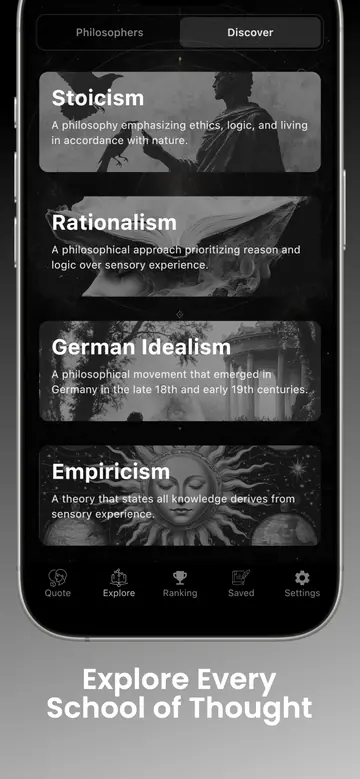
Filter for Stoicism and its major thinkers, schedule one morning notification, keep a widget as the daytime cue, and create separate collections for Judgment, Agency, Justice, and Review.
Use the quote feed for the morning prompt and the Stoicism page for context. When a quote matters, check its author and source rather than saving an isolated slogan. Philosopher profiles let you distinguish the voices of Epictetus, Seneca, and Marcus Aurelius instead of treating “the Stoics” as one speaker.
During the day, a widget can become the pause cue. Do not try to apply every new quote. Keep one passage active long enough to observe it in more than one situation. In the evening, save it only if you can name the exercise it supported; otherwise let it pass.
Daily Reflection and custom collections make review easier, while offline access removes the need for a connection during a quiet routine. The AI Philosopher can help generate comparison questions, but historical claims should still be checked against the source text and reference material.
What Stoicism cannot promise
Stoic practice can offer a disciplined framework for reflection and action. It does not make grief unreal, guarantee calm, remove structural problems, or replace medical and mental-health care. If you are in distress, use appropriate professional and social support. Philosophy is a companion for examining life, not a condition for deserving help.
The measure of the practice is modest: Are your judgments a little more accurate? Are your actions more just? Can you care about an outcome without making character hostage to it? Those questions are difficult enough to sustain a lifetime of work.