
Read one sourced Stoic passage each day, identify the judgment it challenges, choose one response within your control, and review the result without demanding that events obey you.
What Stoicism actually means
Stoicism began in the Hellenistic world and developed through Greek and Roman thinkers. Its practical reputation is deserved, but it rests on a complete philosophy of logic, nature, value, and character. The central aim is not to become cold. It is to live rationally and virtuously, responding to circumstances with justice, courage, practical wisdom, and self-command.
Modern lowercase “stoicism” often means hiding emotion or enduring pain silently. Capital-S Stoicism is more demanding. It asks you to examine the beliefs beneath reactions, distinguish genuine goods of character from external advantages, and treat other people as members of a shared human community. A daily Stoic quote should point back to that ethical project.
The familiar distinction between what is and is not “up to us” comes from Epictetus. It does not promise control over outcomes. It locates responsibility in judgments, intentions, and choices, while recognizing that health, reputation, possessions, and other people's decisions are never entirely ours to command.
“Some things are in our control and others not.”Epictetus, Enchiridion 1
Three Stoic voices worth meeting
Epictetus: train the judgment
Born enslaved and later a teacher, Epictetus focused on the discipline of assent: do not automatically treat an impression as true. His Discourses, recorded by Arrian, and the shorter Enchiridion repeatedly ask what belongs to our agency. Read him when you are tempted to confuse influence with control.
Seneca: philosophy inside complicated life
Seneca wrote essays and letters about time, anger, adversity, friendship, wealth, and mortality while living close to Roman political power. His compromises are part of why he is worth reading critically. He shows Stoic arguments being addressed to recognizably human inconsistency, not to an imaginary perfect sage.
Marcus Aurelius: reminders written to himself
Meditations was a private exercise, not a polished public handbook. Marcus returns to impermanence, duty, attention, cooperation, and the need to correct one's own judgment. Read individual lines as entries in an ongoing self-discipline. The repetition is evidence of practice, not proof that the emperor found the lessons easy.
A five-minute daily Stoic quote method
- Name the subject. Is the passage about judgment, desire, action, relationships, time, or mortality?
- Identify the false promise. What external result are you treating as necessary for acting well?
- Define your part. Name one intention, judgment, or action that remains yours.
- Choose the virtue. Does the moment call for courage, justice, restraint, or practical wisdom?
- Review without self-punishment. In the evening, examine what happened as evidence for tomorrow's practice.
Suppose a quotation concerns insult. The superficial reading is “ignore what people think.” The more useful questions are: What judgment made the remark injurious? Is there truthful criticism to use? What response would be both self-respecting and just? Stoicism does not excuse passivity when action is needed; justice remains part of virtue.
How to avoid fake Stoic quotes
Stoic figures attract modern paraphrases because their style can sound direct and self-contained. Before sharing a perfect sentence, check for a work and section number. Search a complete translation, and remember that different translations may use different terms. If a line cannot be found, present it as a modern summary rather than placing it in quotation marks.
Be cautious with claims that Stoicism is a performance system, a technique for never feeling pain, or a guarantee of success. The ancient texts are concerned with the quality of the agent's character, not dominance over circumstances. A reliable daily Stoic app should make it easy to move from a quote to a philosopher profile, school overview, or source—not keep you inside an endless feed.
Use Philosophia for a daily Stoic practice
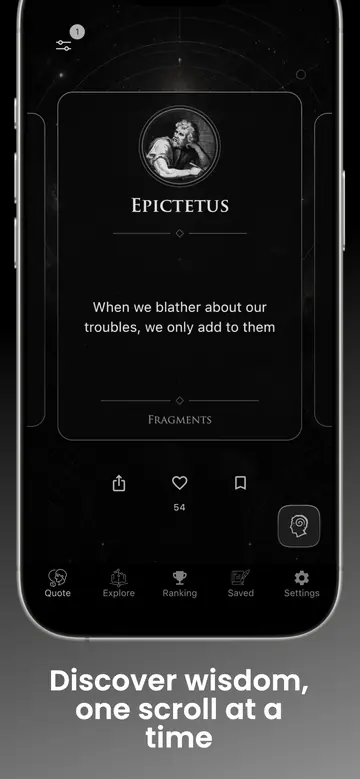
Select Stoic thinkers or the Stoicism school, schedule a morning prompt, add a quote widget, and save tested ideas into collections such as Control, Justice, and Attention.
Philosophia lets you read quotes from Marcus Aurelius, Epictetus, Seneca, and other Stoics while keeping author and source information visible. Use the filters to narrow your feed when building a focused practice, then return to broader schools so Stoicism does not become your only frame.
A Home or Lock Screen widget is helpful for repetition. Place it somewhere visible, but choose one time to engage deliberately rather than glancing all day. When a passage deserves work, save it to a collection named for the discipline it exercises. The same quote may belong under “Judgment” today and “Relationships” months later; your library can change as your interpretation develops.
Finally, use the philosopher and school pages to challenge simplified readings. The goal of a daily Stoic quote is not to borrow Marcus Aurelius's authority. It is to practice examining your own impressions and acting well in the conditions you actually have.